Why is the sky blue?
Our air is made mostly of nitrogen and oxygen molecules. When sunlight enters the atmosphere, it doesn't just pass through — it hits these tiny molecules and gets scattered in all directions.
But not all colors scatter equally. Sunlight is actually a mix of all colors, and each color has a different wavelength — red has a long wavelength, blue and violet have short ones. Short wavelengths scatter much more strongly. This is described by Rayleigh's law: I = k × 1/λ⁴. The shorter the wavelength λ, the much more intensely light scatters.

So why isn't the sky violet? Violet has an even shorter wavelength than blue, so it actually scatters more. But two things work against it: the Sun emits very little violet light to begin with, and our eyes are simply less sensitive to violet than blue.
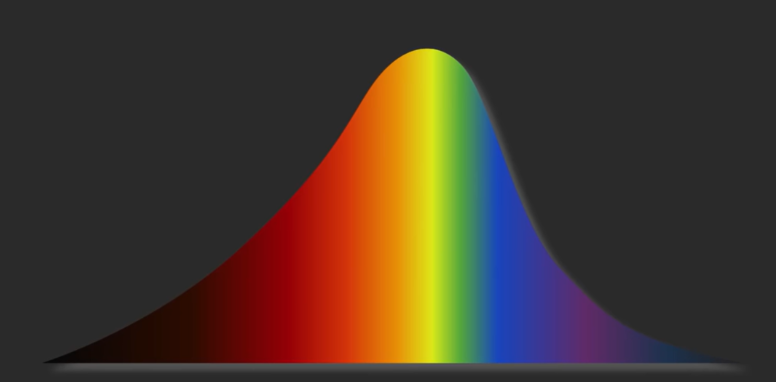
So blue light wins — it scatters strongly, there's plenty of it from the Sun, and our eyes pick it up well. Wherever you look up, scattered blue light is reaching your eyes from all directions. That's why the sky is blue.
Why isn't the sky blue during sunsets?
At sunset, sunlight travels through a much longer path of atmosphere before reaching your eyes. By the time it arrives, the blue light has already been scattered away long before it reaches you. Only red and orange survive that long journey — they don't scatter much.
They travel in one direction, and when the Sun is at a low angle on the horizon, these straight-traveling waves pass through the sky at that same low angle — lighting up everything in that direction in warm reds and oranges.
Why is the sky on Mars orange-ish?

There is a type of scattering called Mie scattering. Unlike Rayleigh scattering, which happens with tiny gas molecules, Mie scattering happens with bigger particles — like dust.
Mars has only 1% of Earth's atmosphere, but it has iron oxide dust, basically rust, constantly kicked up into the air by frequent dust storms. When light hits these dust particles, the iron oxide absorbs more blue and green light than red and orange. So the dust particles scatter orange-reddish light mostly sideways across the atmosphere — lighting up the whole Martian sky in orange.
Why are sunsets and sunrises on Mars blue?
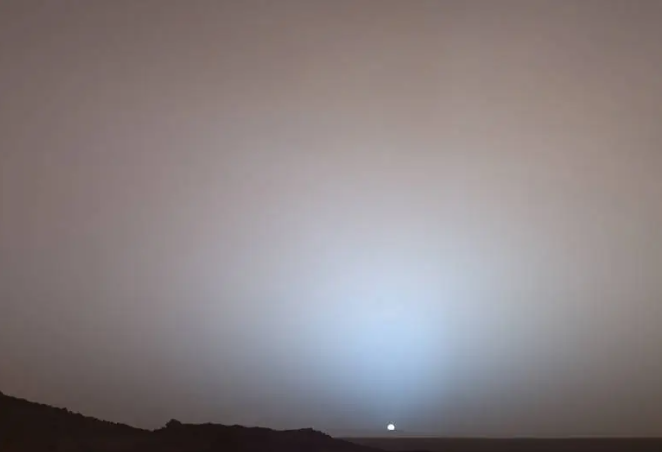
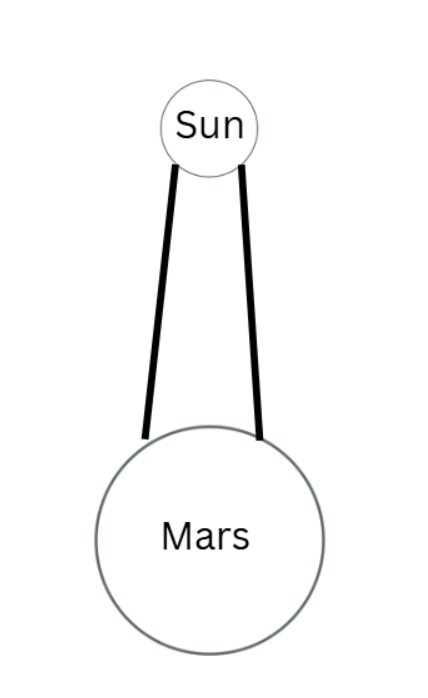
Because at low angles, sunlight needs to travel much more distance through the atmosphere. When the Sun is high, its light travels a short distance to reach you — most of it arrives direct and bright.
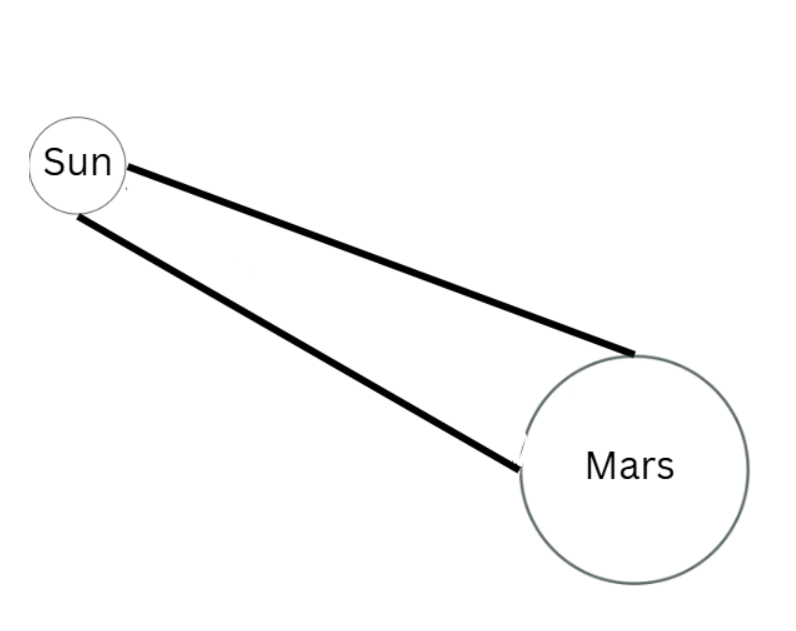
At low angles, the path is much longer. Along that path, most of the red and orange light gets scattered sideways by dust and never reaches you. Now the blue light — which dust scatters more strongly forward — is no longer drowned out. It reaches the observer, forming a visible bluish halo around the Sun.
The same physics, just with different particles doing the work.